
Lindenhurst Village Marina
Village Hall
430 South Wellwood Ave
Lindenhurst, NY 11757
Department of Public Works
121 Albany Ave
Lindenhurst, NY 11757

Charles J. Cowan Village Marina
Marina is open from April 1 – December 15.
Crabbing Permit – In order to crab at the Charles J. Cowan Village Marina, an individual must have a crabbing permit. Crabbing permits can be obtained at Lindenhurst Village Hall, 430 South Wellwood Avenue.
Fishing License – Although fishing is permitted at the Lindenhurst Village Marina, the Village of Lindenhurst does not issue fishing licenses. In order to obtain a fishing license, please contact the Town of Babylon (631) 957-3000. Fishing licenses can also be obtained by visiting the Department of Environmental Conservation website here: https://decals.dec.ny.gov/DECALSCitizenWeb/citizenhome.htm
Marina Parking – Lindenhurst Marina parking is available to both Village residents and non-residents. Marina parking permits are available at no charge to Village residents. Marina parking permits are available at a fee for non-residents. License and car registration must be presented when obtaining a parking permit. Marina parking permits can be obtained at Lindenhurst Village Hall, 430 South Wellwood Avenue.
Dock Space – A Lindenhurst dock space can be applied for through a lottery held by the Village. The lottery is open to residents and non-residents. The completed lottery must be received at Village Hall, 430 South Wellwood Avenue, Lindenhurst, NY 11757 or sent through email at parking@villageoflindenhurstny.gov by April 1, 2024. 2024 Dock Space Lottery Form or 2024 Jet Ski Lottery Form.
Importance of Boat Safety:
1. Protecting People:
- Prevents Accidents: Adhering to safety measures and speed limits helps prevent collisions and accidents. High speeds can lead to dangerous situations, including capsizing and losing control.
- Reduces Injuries: No-wake zones are often in areas with a lot of boat traffic, such as docks, marinas, and narrow channels, where high speeds can lead to accidents and injuries.
2. Preserving the Environment:
- Reduces Erosion: Wake waves from fast-moving boats can cause significant shoreline erosion, harming habitats and potentially causing damage to property.
- Protects Wildlife: High speeds can disturb or harm wildlife. Respecting no-wake zones helps minimize this disruption.
3. Ensuring Property Safety:
- Protects Docks and Boats: Large wakes can damage docks, boats, and other structures, leading to costly repairs and maintenance.
- Preserves Infrastructure: In areas where there are docks or floating structures, wake waves can accelerate wear and tear.
4. Legal and Regulatory Compliance:
- Avoids Fines: Many waterways have regulations regarding boat speed and no-wake zones. Violating these rules can result in fines and legal trouble.
- Supports Community Norms: Following local regulations helps maintain good relationships with other boaters and residents who depend on shared waterways.
5. Promoting a Positive Boating Experience:
- Enhances Enjoyment: Adhering to safety rules and respecting no-wake zones helps ensure a safe and enjoyable experience for everyone on the water.
- Encourages Responsible Behavior: Respecting these regulations promotes a culture of safety and responsibility among boaters.
Overall, boat safety and adherence to no-wake zones are essential for the well-being of people, protection of the environment, and maintaining the integrity of waterways and infrastructure.
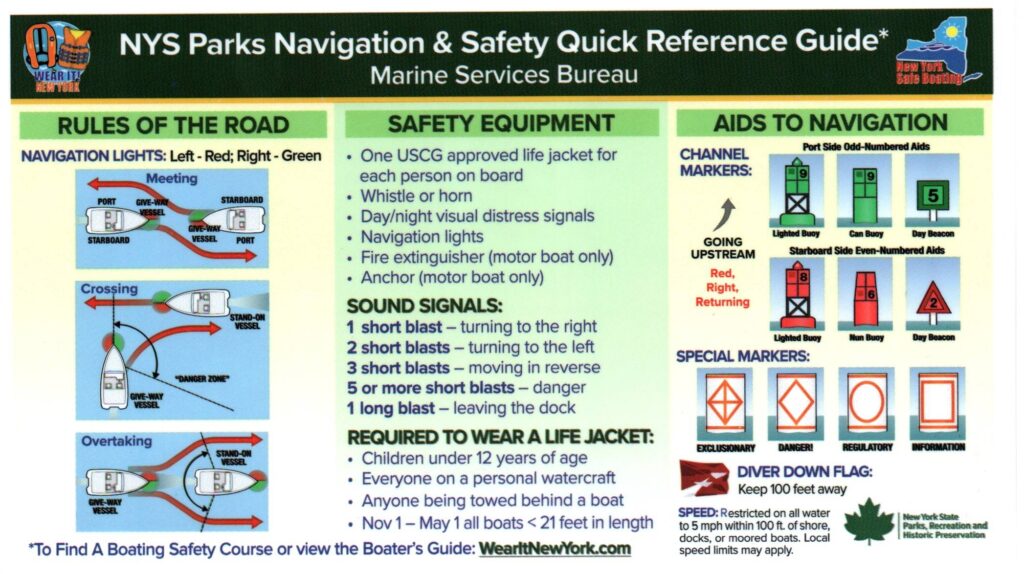
Helpful Links:
Boating – NYS Parks, Recreation & Historic Preservation
New York State Department of Environmental Conservation (ny.gov)